Reliable, actionable KPI reporting is an essential tool for any business transitioning from founder-driven entrepreneurialism to scalable, sustainable, and profitable growth. In our ever-more digitalised operating environments, performance indicators are abundant – and there is clear benefit to functional leads and individual contributors being able to measure and manage the operational details that contribute to your top-level financial performance.
For a Founder, CEO, Board or Executive Team, however, the most critical component of KPIs is the word ‘Key’ – what are the 3 to 5 Performance Indicators that best summarise the operating strength of your business, best represent whether your strategic initiatives are working, and most effectively enable agile diagnosis of where to double down and where to course correct?
For B2B information businesses, one of those KPIs is Annualised Contract Value (ACV), which earns its place for four reasons.
Four reasons why ACV belongs on your KPI list
1. ACV is a forward indicator of Revenue.
Revenue in the P&L is inherently backward-looking, and the deferred nature of Subscription Revenue means that problems brewing today may take 6-12 months to fully manifest in the P&L – during which time the problem has likely grown. ACV shows it sooner.
Today’s ACV is the annual value of every subscription that has started on or before today and ends on or after today, within contracts signed (or committed through auto-renewal terms). Divide today’s ACV by 365 and you have today’s earned Revenue. If today’s ACV is greater than the last 12 months’ earned revenue, your subscription business is growing.
2. ACV reduces the noise of sales and invoicing.
That noise can hide true year-on-year growth and performance against plan. Pulling renewals forward to fill a gap in the sales forecast does not flatter today’s ACV owing to the date criteria in its definition. Multi-year deals that you may recognise up front as Sales, or short bridging deals necessary to realign ongoing relationships with customers’ budget cycles, are naturally adjusted for through annualisation. This also makes ACV the ideal metric for sales commission plans, as opposed to Sales or Revenue.
3. ACV breaks down into the drivers of growth.
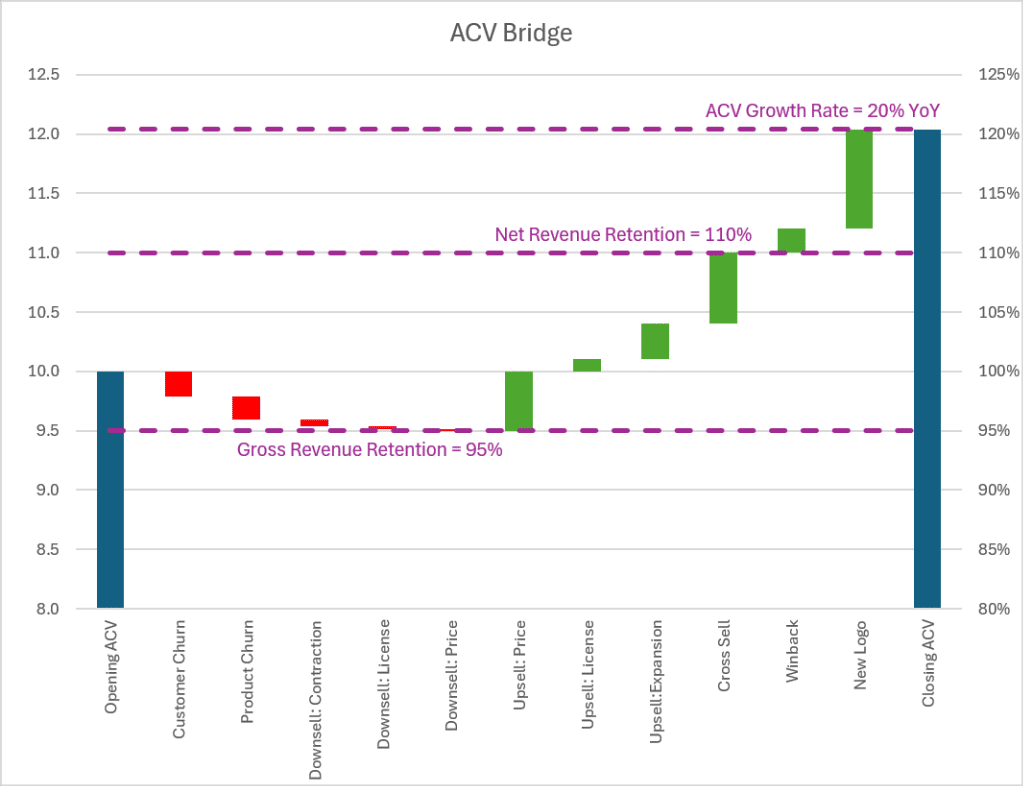
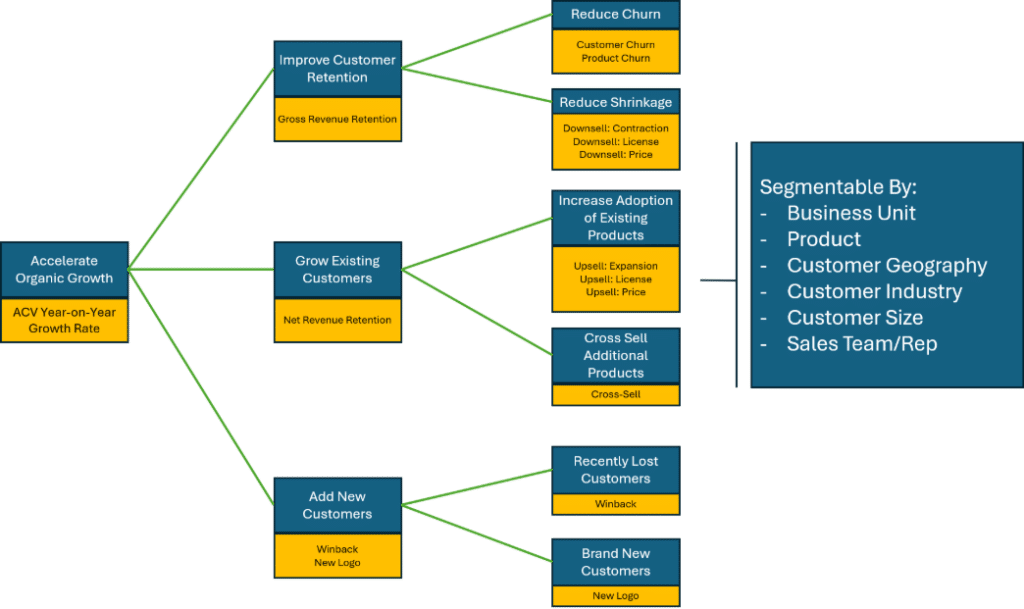
You can split movement in ACV into customer retention, upsell and cross-sell to existing customers, and new customer acquisition. With well-managed customer and product master data, the Drivers of Growth can be naturally segmented by product, geography, industry, customer tier, and sales rep / team. This will show – in real time – what or who is working well, and what requires attention.
4. Investors know and respect it.
Private equity firms and strategic trade buyers understand ACV and the drivers of growth. When you need to show the value of your business, an established ACV reporting capability (and track record of acting on it) supports a stronger valuation.
ACV Drivers of Growth in the Real World
For the incoming Executive team of the newly-formed Informa Intelligence in 2014, the exam question was how to take an apparently flat subscription business (based on 2012-2013 earned revenue) and return it to growth. Headline ACV reporting was available, though poorly adopted and understood, and it indicated a stiffer challenge – an almost 10% decline in ACV year-on-year as at June 2014, primed to show up as accelerated revenue decline as H2 2014 played out.
The new team had a mandate to invest in the business, but urgently required both a more detailed diagnostic of what needed fixing, and a way to evaluate whether investments were paying off. Informa Intelligence had five divisions, each with multiple product brands accumulated through three decades of acquisitions. A single prescription would not necessarily apply across the board. To meet that challenge, the existing ACV reporting was enhanced to more granularly measure the underlying Drivers of Growth, and link them to real world changes to be made.
The analysis set the investment direction:
Some products had a high new business rate, but low revenue retention – the ‘leaky bucket’. Others showed the reverse: revenue retention over 90%, but only 10% new business. The team rebalanced sales coverage and resource between renewal and new business, product by product.
Key accounts drive overall ACV growth, because the largest companies often make up 50% or more of the total addressable market (TAM). Upsell and cross-sell rates varied by product, region, and account manager. Where required, the team trained its account managers and recruited strategic account management skills.
For some products, aggressive price increases flattered Net Revenue Retention, but were simultaneously driving customers away (which showed as low Gross Revenue Retention). The team held prices flat for two years to protect volume retention until product investment started to deliver increased value and justify price increases.
ACV returned to growth within 18 months, and then steadily improved year-over-year through to 2021, when most of the division was sold to Private Equity for more than £2.5bn.
How the Deep Niche Mindset connects to ACV
Reporting shows you where you stand. Collingwood’s Deep Niche Mindset provides a framework to build a great subscription business. ACV Drivers of Growth reporting forms part of Professional Governance, People and Process, one of the five Collingwood Value Drivers for the information, media, and events businesses.
When you claim your niche and build essential proprietary content, you will see high gross and net revenue retention, supported by strong price upsell. Layering high-value solutions, and a tiered account strategy that directs sales resource, lifts cross-sell and upsell (License and Expansion). Delivering on the Deep Niche Mindset is a multi-faceted and multi-year endeavour. Clear sight of your ACV Drivers of Growth shows where you are succeeding and what needs work, enabling you to reach your goals with greater speed and confidence.
Download Collingwood’s Deep Niche Mindset report, for leaders of B2B information, media, and events businesses who are serious about accelerating growth and enhancing profitability.
ACV Drivers of Growth Definitions
Note: ACV, ARR (Annual Recurring Revenue) and MRR (Monthly Recurring Revenue) are closely related, the distinction being that ACV includes only contractually committed revenue, whereas ARR and MRR can incorporate more variable elements like usage-based charges. We use ACV in this article, as most business information models do not include such variable charges, but the Drivers of Growth can be similarly calculated from ARR and MRR.
| Metric Name | Metric Definition |
| Opening ACV | ACV of active subscriptions at beginning of measurement period |
| Closing ACV | ACV of active subscriptions at end of measurement period |
| Customer Churn | Opening ACV of subscriptions that are not Renewed, where the Customer has no other active subscriptions |
| Product Churn | Opening ACV of subscriptions that are not Renewed, where the Customer does have other active subscriptions but not for the same Product |
| Downsell: Contraction | Opening ACV of subscriptions that are not Renewed, where the Customer does have other active subscriptions but for the same Product |
| Downsell: License | For all subscriptions that are renewed, but with a reduced license (e.g. fewer users), Closing ACV minus Opening ACV |
| Downsell: Price | For all subscriptions that are renewed, with no change of license, Closing ACV minus Opening ACV (where that is < 0) |
| Upsell: Price | For all subscriptions that are renewed, with no change of license, Closing ACV minus Opening ACV (where that is >= 0) |
| Upsell: License | For all subscriptions that are renewed, but with an increased license (e.g. more users), Closing ACV minus Opening ACV |
| Upsell: Expansion | ACV of New subscriptions from Existing Customers that already have at least one other active subscription for the same Product |
| Cross Sell | ACV of New subscriptions from Existing Customers that do not have any other active subscriptions for the same Product |
| Winback | ACV of New subscriptions from Customers with no other active subscriptions, but did have at least 1 active subscription that ended within the previous 12 months |
| New Logo | ACV of New subscriptions from Customers with no other active subscriptions, with no other active subscription ending within the previous 12 months |
| Gross Revenue Retention | (Opening ACV – Churn – Downsell) / Opening ACV |
| Net Revenue Retention | (Opening ACV – Churn – Downsell + Upsell + Cross Sell) / Opening ACV |
Aligning metrics to what is actually Driving Growth
One example graphical output – the ACV Bridge